A fragment from the TimeTravel Diaries of Elizabeth Bicester.
“ I have, for most of my life, regarded fairies as a matter best confined to childhood, poetry, and the more speculative regions of Celtic folklore.
They were, I understood, creatures of suggestion rather than substance—useful, perhaps, for explaining unusual lights in the woods, misplaced objects, or the curious small children to wander off at inconvenient moments.
In short, they were not to be taken seriously.
This position has, of late, become increasingly difficult to maintain
My change of view does not arise from any sudden inclination toward superstition, but rather from a series of observations during our time travels which, taken individually, might be dismissed, but, when considered together, present a rather more troubling conclusion.
I refer, of course, to the Martians.
It has been put to us, initially as a conjecture, and later with a degree of confidence which I found disconcerting, that these beings have been present upon the Earth for a considerable period of time. Not recently, nor as the result of any modern experiment or misadventure, but for thousands of years.
At first, this seemed improbable. However, we have since encountered them,and I cannot say that the experience was reassuring.
They are not, as one might expect from certain scientific romances, monstrous or mechanical in nature. On the contrary, they are slight, almost delicate in appearance, and possessed of a curious luminosity which renders them at once visible and indistinct.
In dim light, they bear a striking resemblance to the fairies described in the tales of my childhood. But this resemblance might, under ordinary circumstances, be dismissed as coincidence.
It is less easily dismissed when one is informed, quite directly, that the fairies, the Sidhe, and other such beings of legend are, in fact, one and the same as the Martians.
I confess that I resisted this conclusion. However, the more one considers the matter, the less unreasonable it becomes.
The ancient accounts are remarkably consistent in certain respects. Fairies are said to appear and disappear without warning, and to move between worlds by means not available to ordinary persons.
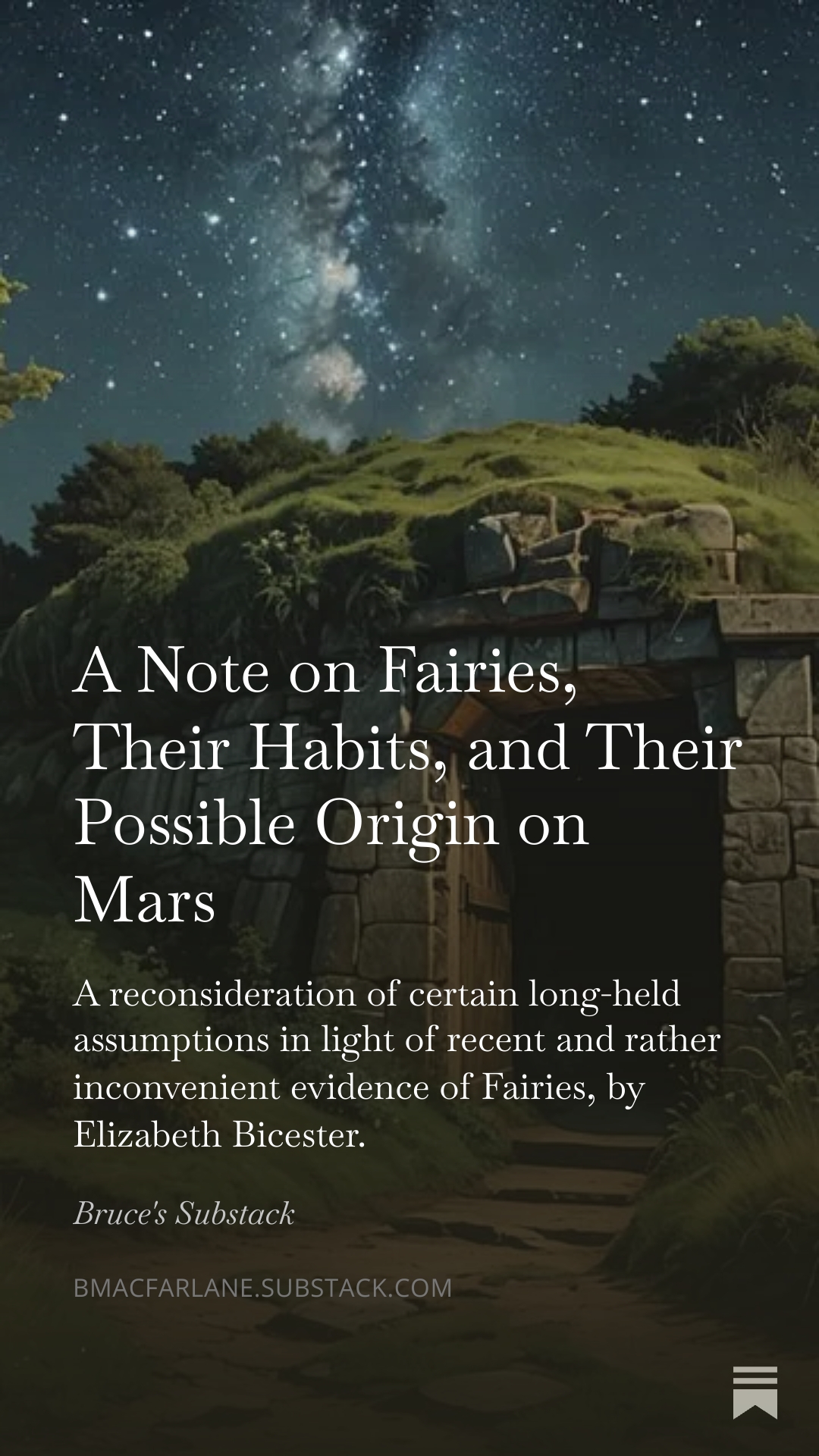
We have also discovered that the locations traditionally associated with these beings, namely the ancient mounds and barrows which dot the countryside are not, as I had always supposed, merely places of burial or ritual, but serve a more practical function.
Structures such as Newgrange, and others of similar construction across Britain and Ireland, are said to act as points of transition, or what James insists on calling “portals.”
These, it would appear, permit passage not only between different regions of our own world, but between entirely different worlds, including Mars.
They are also credited with an uncertain relationship to time. Visits which seem brief to the traveller may correspond to years in the world left behind.
These characteristics, I am informed, are entirely consistent with the behaviour of beings capable of moving not only through space, but through time.
It would appear that what was once attributed to enchantment may, in fact, be the result of a more advanced understanding of natural philosophy.
There is a certain charm in believing that the world contains small, mischievous beings who dance in moonlit circles and concern themselves with trifling domestic interferences.
It is rather less charming to discover that such beings may instead be engaged in the observation, and occasional manipulation of our lives across multiple possible futures.
They do not perceive us as we perceive ourselves. To them, we are extended through time, our past and future visible in ways which render our present moment somewhat less significant than we might prefer.
This, I think, explains a great deal. It may also explain why they have, for so long, avoided any direct and unambiguous introduction.
It is difficult to conduct a polite conversation with someone who can see how it will end. I am therefore obliged to revise my earlier position.
Fairies, it seems, are not imaginary.
They are merely… misidentified.”
Elizabeth Bicester. The First of May, 1873. Hamgreen, Sussex.
From The Time Travel Diaries Substack